Showing posts with label Montezuma. Show all posts

April 6, 2011

Chocolate: Quetzalcoátl's Gift to Mexico and the World

With the approach to Easter, many people are out there buying up chocolate eggs or chocolate bunnies. Beyond the religious aspect, Easter means chocolate in homes throughout the world. But have you ever wondered where it came from? The clue is that it was once considered a gift from the god, Quetzalcoátl, and only the Atzec ruling classes and priests were allowed to consume it. It was not a candy for mere mortals. Yes, chocolate comes from Mexico.

Maya chief and chocolate
A Maya chief refuses chocolate to a commoner

Chocolate is a Spanish rendering of the Atzec word xocolātl, meaning sour (xococ) drink (ātl). An alternative theory is that the word was Mayan. Here it would come from hot (chokol) drink (ātl). As either interpretation highlights, chocolate was always used as a beverage in Mexico. It was only after the Spanish took it into Europe, that it became more commonly seen as a solid block.

The legend goes that, in 1519, Hernán Cortés, the Spanish conquistador, was granted an audience with the Atzec Emperor Moctezuma. This took place in Tenochtitlán, which is the modern day, Mexico City. Cortés and his men entered to find Moctezuma sipping xocolātl from a cup. As honored guests, the group were all served xocolātl. It was reported that the drink had 'a very exciting nature'. Forget the gold! They had just discovered chocolate! Thus Mexico's secret was out and its Fate was sealed.

Mexico and chocolate

Chocolate literally does grow on trees in Mexico. At least the cacao beans do, which are then ground up and treated to create chocolate. Cacao trees have been cultivated since around 1400 BCE. The Olmec appear to be the first to have created their sacred bitter drink from its ground beans. The Maya were next, with archealogical evidence showing that they were drinking chocolate from about 400 CE. Cups have been found, with a chocolate residue, dating from this period. Digs, at their historical settlement sites, have shown cacao trees being grown in their backyards.

Quetzalcoátl and chocolateThe Atzec people saw chocolate as a divine drink. It was a gift from the feathered-serpent god, Quetzalcoátl, who had fetched the cacao beans from the Garden of Life.

As such a holy thing, chocolate was initially reserved only for the most ceremonial occasions. It was ritually prepared and drunk only within sacred areas.

Over the years, this was relaxed so that the higher echelons of society could imbibe it. However, it never lost its association with deity; so much so that, it was later at the center of a Christian scandal. The Catholic Church was brought into Mexico by the Spanish. It eventually become strong enough to start to eradicate the items and practices of the religions it had usurped. One bone of contention was that converts would bring chocolate drinks into Mass. The congregation were using it to honor the Catholic God, not Quetzalcoátl, but it made no odds. It was deemed as breaking the fast, in a Pagan way, and so the Church hierarchy banned chocolate outright.

Cacao Plantation
Cacao tree with pods full of beans

This did not go down well. As each Catholic priest prohibited chocolate, then the congregation would up and leave, moving onto more lenient institutions. It was a battle of wills that eventually resulted in the Bishop of Chiapas threatening excommunication to anyone drinking chocolate. (He was killed, shortly afterwards, after he drank a cup of poisoned chocolate. It was handed to him by the same group of noble women, who he had just banned from drinking the very same.)

Finally, in 1662, Pope Alexander VII had to personally intervene. He ruled, "Liquidum non frangit jejunum!" (For those with rusty Latin, that basically says that liquids do not constitute breaking the fast.) In short, the Mexicans could drink all of the hot chocolate that they wished and still be regarded as fasting. The church's chocolate ban was lifted!

Of course, now the Catholic Church is firmly on the side of chocolate. In Mexico City's Metropolitan Cathedral, there is a 16th century sculpture of Jesus Christ. It is called El Señor del Cacao (The Lord of Cacao).

El Señor del Cacao
El Señor del Cacao

The error has now been firmly corrected. It was not Quetzalcoátl who gave chocolate to the world, via Mexico; it was Christ Himself.

champurradoChocolate became popular, on a global scale, after a group of Mexican nuns thought to add vanilla and sugar to the chocolate mix. Overnight, it stopped being a sour drink and started becoming very sweet instead.

It is also a major ingredient in the Mexican national dish: Mole Poblano; as well as a stable of drinks, such as champurrado, and dips, to be used with churros.

Chocolate is still widely produced in Mexico, with cacao plantations stretching for miles. The World Cocoa Foundation estimates that 50 million jobs, internationally, rely upon cacao trees and the chocolate industry. Forget Willy Wonka. The real chocolate factories are scattered all over Mexico. Nestlé, Hersheys and Barry Callebaut are amongst the companies that create their confectionery here, before exporting them into shops near you. Chocolate is also created, straight from the tree, in many Mexican homes.

January 18, 2011

Montezuma's Headdress Could Be Coming Home

Montezuma's Headdress
Original headdress (Museum of Ethnology, Vienna)

It has taken three years of long negotiation, on top of decades of lobbying and centuries of wishful thinking. Now that is drawing to a conclusion: the headdress, believed to have belonged to the last Aztec king, might be returning to Mexico. So many of these treasures were taken from the country, during the Spanish conquest, that only reproductions remain. Now Mexicans may finally get the chance to see the original.

The headdress was removed from the country, during the 16th century, by Spanish conquistadors. Curios from the New World were big business then, as connoisseurs scrambled to see and understand what was being discovered so far overseas. Artifacts could be used in politics and religion, justifying the taking of land from apparently barbaric, Pagan people. Priests could hold up siezed icons to illustrate cautionary sermons about sympathizing with Satan. Alternatively, items could be bought by collectors, to be displayed as novelties.

Montezuma's Headdress
Reproduction headdress (Museo Nacional de Antropología, Mexico City)

This particular Aztec headdress had found its way, by 1575, into the private collection of Ferdinand II, Archduke of Austria. Ferdinand was the son of Ferdinand I, Holy Roman Emperor, and the younger brother of Maximilian II. He controlled substantial territories of his own, but even the vast revenue from those couldn't match his appetite for purchasing art. He died leaving huge debts, but also a famous collection in Castle Ambras, Tyrol, Austria. Amongst them was a horde of priceless Mexican antiquities.

At the beginning of the 19th century, the treasures of Castle Ambras were deposited in the Museum of Ethnology, in Vienna, Austria. European experts rushed in to examine the artifacts, finding particular fascination in the headdress. However, all of them believed that it was a mantle. It was left to a visiting US anthropologist, Zelia Nuttall, to explain its real function. She also identified it as being from Quetzalapanecayotl Palace.

Montezuma's Headdress
Artist's impression of Montezuma wearing the headdress

Whether the headdress had been attributed as belonging to Montezuma before is debatable, but it certainly was afterwards. Montezuma (aka Moctezuma II) was the most famous of Aztec rulers. He lived in the city that later became Mexico City; and did so at the time of the Spanish conquest. There is no actual proof that the headdress ever belonged to him. But it could well have. The headdress was taken from the right place, at the right time. Anyway, its designation, as Montezuma's headdress, added a layer of intrigue that brought in the European crowds to view its exhibition. In Mexico, it is also commonly called Penacho de Moctezuma.

quetzalquémitlMexican historians have an different interpretation. They believe that it may have been worn by a priest. It's been suggested that it may have been a mantle all along. Called a quetzalquémitl (feather cape), it would have transformed the priest into a living embodiment of the God, Quetzalcoátl. It is to examine it more closely, so that these questions may be addressed, which is the main impetus for asking for its return.

The Mexican Ministry of Foreign Affairs (SRE) and the National Institute of Anthropology and History (INAH) have been locked in talks, for the past three years, with their counterparts in the Austrian government and Kunsthistorisches Museum officials. The Museum of Ethnology, where the headdress is currently on display, is under the jurisdiction the Kunsthistorisches Museum. Mexico's President Felipe Calderon has been personally involved in the negotiations.

Carriage of Emperor Maximilian of Mexico

As a gesture of good-will, the headdress will be exchanged for a golden stagecoach used by Mexican Emperor Maximilian. He was a member of the Austrian royal family. However, the Austrians have made it quite clear that the exchange is a temporary loan. Sabine Haag, director of Kunsthistorisches Museum, told an Austrian radio show that the headdress belongs in Austria.

We understand of course that the Penacho has a deep symbolic and spiritual meaning for Mexico's native population, and we are therefore in the process of coming up with conservation measures in order to store and exhibit it as part of Austria's and Mexico's cultural heritage.
Sabine Haag, on Radio Oe1

The final stretch of the talks are centring on how to transport both the headdress and the stagecoach, with due regard to legalities of both countries. Then experts need only to address the practicalities of sending such historically precious treasures halfway across the world.

August 18, 2010

Montezuma's Revenge

When setting out to choose the blog topic of the day, I often look first at perennial tourist questions. These are vacationers who have looked at the pretty beaches, the vibrant nightlife, the world heritage class tours, the fun attractions and are already excited about a vacation in Mexico. But then they spot something and worry about it. Enter this blog to evaporate the mystery, so that the worrying at least has some basis in fact.

MontezumaMontezuma's Revenge is not:

* A vengeful ghost intent on human sacrifice;
* Some kind of vague, non-specific scam enacted by all Mexicans against all tourists;
* A curse which brings bad luck to anyone visiting a certain site or touching a certain rock.

All of the above are your internet friends trying to troll you. The real Montezuma's Revenge is a lot murkier than that. It's traveler's diarrhea.

Wherever we live, our bodies become used to the local water and the local food. People generally think that water is largely tasteless, until they travel to another city or state, even within their own country. That's when the discovery is made that water can be 'hard' or 'soft', or have discernibly different aftertastes, depending upon which filtering and cleaning chemicals are used by which local authority. 'Hard' water will have a higher mineral content than 'soft' water. But if the water is too soft, it might erode our household plumbing. Some processing plants are required, by local law, to add extra chemicals, if there's a profusion of fungi or algae caused by your landscape.

However the water is treated, we each build an immunity to all that's in it. Our bodies recognize that this is how water should taste and those are the minerals and chemicals that should be in it. They cause us no harm (no water processing plant is going to add harmful chemicals!) and life goes on. Until, that is, we go on vacation. Suddenly we have a whole different kind of water and our bodies have to suddenly reassess the situation. For some, with robust constitutions, this change happens with no side-effects at all; but for those with more fragile stomachs, their bodies can panic. They will treat the difference as poison and try to expel it from themselves. Hence the diarrhea.

toilet roll


This isn't a problem peculiar to Mexico. It simply seems that way, because this is the vacation destination for millions of Americans, Canadians and those further afield around the world. This might be the only time that those tourists drink water that is treated differently to that at home. However, it's not called Montezuma's Revenge everywhere. The Turkish Two-Step; Bali Belly; Pharaoh's Revenge/Cairo Two-Step; Kurtz Hurtz (Uzbekistan); Beaver Fever (Canada); Katmandu Quickstep, are just a selection of the alternative names for traveller's diarrhea. It happens wherever people drink different water or eat different food to that which their body has formed its immunity.

It is referred to as Montezuma's Revenge, when it occurs in Mexico, because of the Aztec Emperor, Montezuma II. He is alternatively known as Moctezuma II and his story was told in a previous blog entry: Mexico City - The City of the Gods. The short version is that he was the Aztec ruler at the coming of the Spanish. It was his empire that was over-run by the invasion force of Hernán Cortés. Montezuma II fought back valiantly against the conquistadors, but the upshot was that he lived to see his empire in foreign hands and he died in chains under their rule.

If the spirit of Montezuma II was wishing to wreak revenge upon the modern invaders (tourists), then it could be imagined that it would be more bloody than an upset stomach. Nevertheless, the wry moniker 'Montezuma's Revenge' has been applied to just that.

No resort, nor business reliant on the tourist trade, wants to see their clientele confined to their bathrooms, groaning. Bottled WaterTherefore, you will find plentiful bottled water in Mexico, particularly where those on vacation congregate. Drink only this, rather than water from the faucet/tap and you'll be fine.

Ensure that you also brush your teeth in bottled water, plus that the ice in your drinks is from bottled water, for that extra security. If you are self-catering, then only wash your food in bottled water. You get the general idea! The restaurants and other eateries, in the tourist zones, will be using this in their food preparation anyway, as they are the last people who want to be accused of causing Montezuma's Revenge. Therefore areas like Cancún see very few cases of traveller's diarrhea.

If you do end up as one of the 20% of vacationers, travelling world-wide, to fall foul of traveller's diarrhea, then don't panic. It is inconvenient and downright disappointing, when you've saved up to come away, but it's usually easily treated.

Symptoms are loose bowels; abdominal cramps; nausea; and a bloating feeling. All of the above are your body's way of trying to expel something, which it considers poisonous, from your system. It is not contagious, so milk it for all the sympathy that you can get from the rest of your party; but equally don't be afraid to allow them back out into the wide world. They will not be carrying some dire virus. By the same token, if you can find somewhere with easy access to a bathroom, then you can go out yourself.

The most important treatment is fluids. Drink as much bottled water as is comfortable, so to flush out your system, and replace all of those fluids that you are losing by other means. You are also losing salts, so water primed with hydration salts is the best of all. Try to avoid alcohol, as a main way to take on fluids, as that can actually dehydrate you. Bottled soda works for some, but not others.

Drug Store Cancun


It might be worth a visit to the local drug store/pharmacy/chemist, as they would be well aware of the local variation of traveller's diarrhea. You might be able to get something over the counter to hurry along your body's stablization. It may take anywhere between one and five days to feel right again; with the average being 3.6 days.

If the symptoms are very severe, or there is blood in your stools or a high fever, then seek urgent medical advice. It might not be traveller's diarrhea, but indicative of something else.

Here's hoping that you never get traveller's diarrhea in Mexico. But if you do, at least you now know that it's only the occasional uncomfortable rush to the bathroom, and not the dismembering wrath of an Aztec king.

June 11, 2010

Mexico City - The City of the Gods.

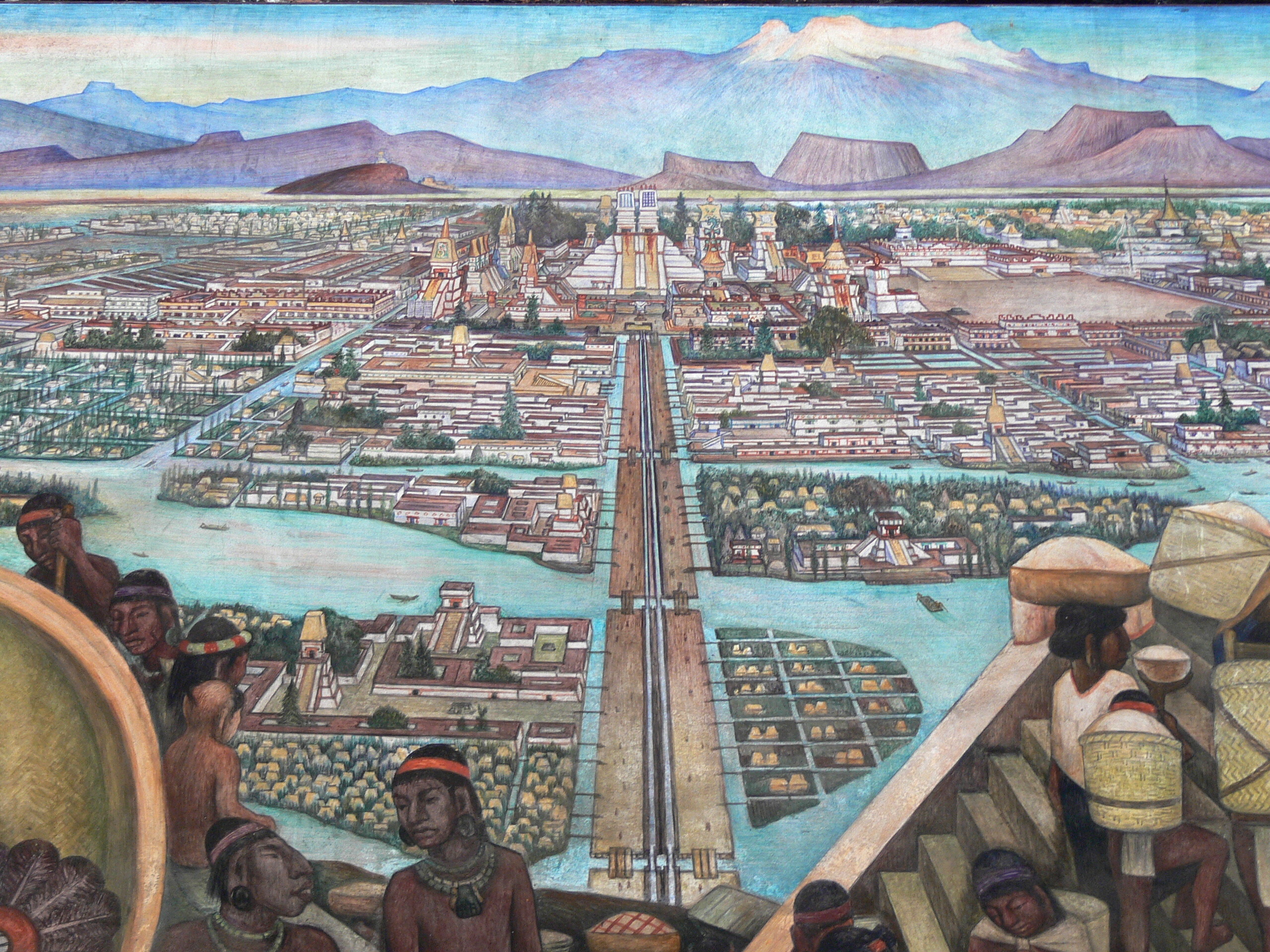
It was 1519 and the Spanish Conquistadors had been hearing about the fabled Aztec capital city of Tenochtitlán all the way from Veracruz. Their leader, Hernán Cortés, was determinded to find it. As they marched across the country, moving ever closer towards it, the descriptions became more fantastic, more lavish. The Spanish covered hundreds of miles, through difficult, ever-changing terrain, lured on by the knowledge that this was the big one. If Tenochtitlán had just a fraction of the grandeur promised by reports, then it would be the jewel of their new empire. It would make them rich men. It would make Spain the envy of the world.

Tenochtitlán


Then there it was, in the valley below. The largest, most glorious city in the Aztec Empire. It was home to 100,000 people, including their ultimate ruler, Emperor Moctezuma II. Tenochtitlán glittered, in ornate splendor, upon a massive island in the midst of an even larger lake. It connected to the mainland by three causeways. It held the Emperor's palace and several huge temples - with the main temple, bigger and more richly endowed than any seen before. Fertile gardens and canals intersected the city at strategic points. Tenochtitlán surpassed all stories told about it on the journey there. It was the greatest display of wealth, ingenuity and beauty in all the Aztec lands. It was more splendid than any European city of the time; smaller only than Constantinople. Hernán Cortés wanted it.

It would take the Spanish two years to take Tenochtitlán, despite forces swelled by the enemies of the Aztec, the Tlaxcalans. Aztec legend had told of the return of the god Quetzalcoátl. It was reported to Spain that, initially, Emperor Moctezuma II had assumed that Cortés was this deity and so had invited him into the city. They were lauded in luxury, feasting on food fit for kings. Moctezuma dressed him with flowers from his own garden, a great honour, though Cortés didn't understand the significance of the gesture. Cortés, along with his 3000 Spanish and Tlaxcalan entourage, were installed in the palace of Moctezuma's own father.

It didn't take long for Cortés to start making demands. At first these were humoured. Gigantic icons of Aztec gods were removed from the central temple; shrines to the Virgin Mary and St Christopher were set up in their place; a seemingly endless supply of gold was produced and handed over as gifts (or tribune, depending on who is telling the story). Cortés responded by seizing Moctezuma in his palace and holding him hostage.

Over the next two years, war raged throughout the city. Cortés left at one point to intercept a Spanish force coming to find and execute him for disobeying orders; but he successfully defeated them and persuaded the survivors to join his own cause. At times, the Aztec repelled the Spanish from Tenochtitlán. Moctezuma died in chains under Cortés's care. The fighting went on, sometimes house to house, street by street. It was never a foregone conclusion that the Spanish would win. On the night of 1 July 1520 alone, 600 Spanish and several thousand Tlaxcalans were killed, while trying to flee the city in the face of a massive Aztec force.

The war continued on the mainland, in pitched battles throughout the surrounding countryside. Without the Tlaxcalans swelling their ranks in their thousands, the Spanish would never have taken Tenochtitlán. When they did, it was as the result of a long, drawn out seige. For eight months, Tenochtitlán was surrounded. Its inhabitants could not cross the lake for supplies. Inside the city, food was rationed, then became scarce. They were bombarded with cannon fire. European diseases, like smallpox, ripped through the population, which had not been exposed to it before (a third of the population of the whole valley died in six months from smallpox). Until, 13 August 1521, the last Aztec Emperor, Cuauhtémoc, surrendered the city.

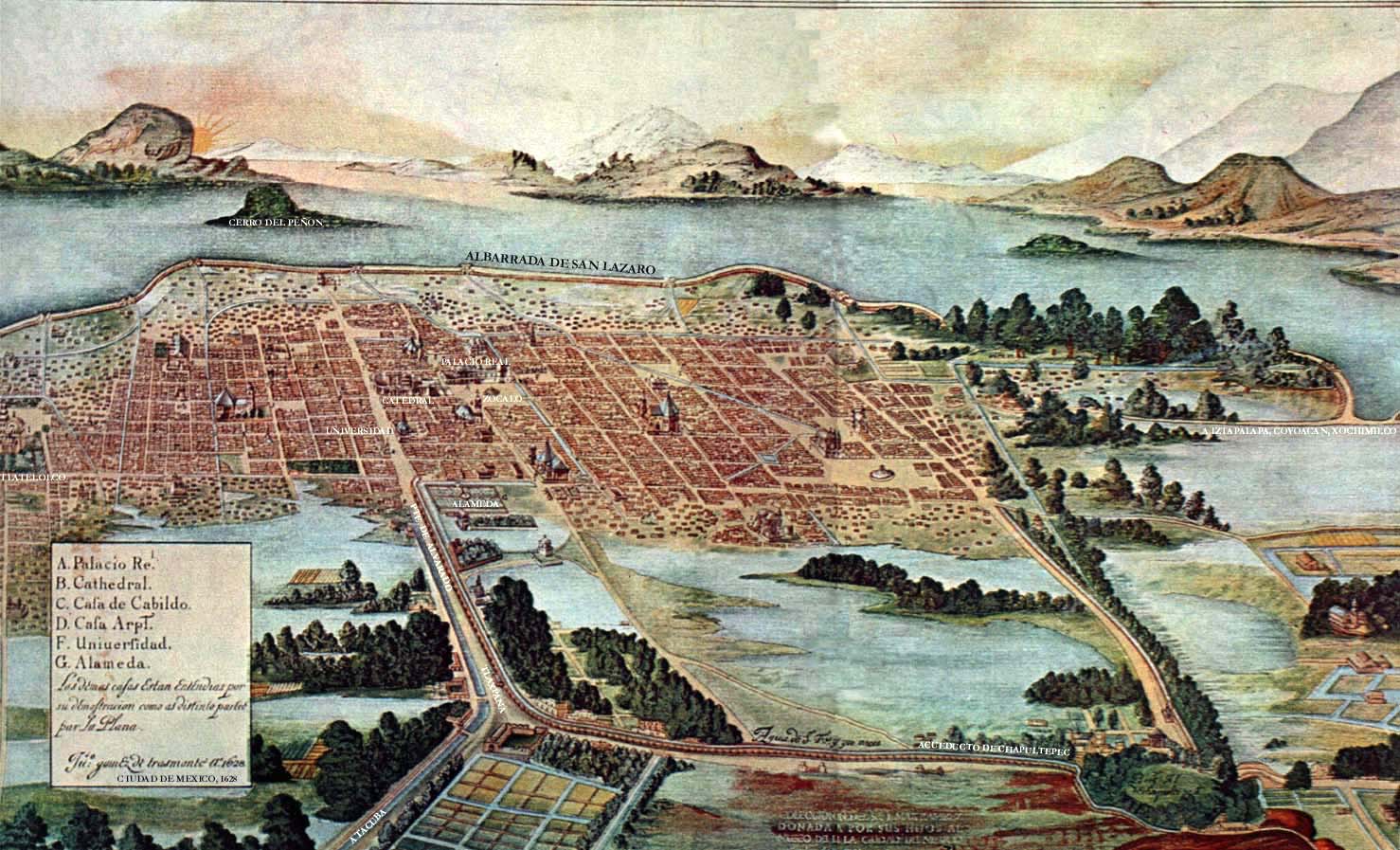
Cortés moved in immediately. He asked for gold, food and women with fair skin; then he expelled the rest of the Aztecs from the city. Cuauhtémoc was tortured and executed. The population were banned from ever returning to it nor even the surrounding countryside. Then Cortés set about rebuilding Tenochtitlán. It was to be even more ornate and glorious. Spanish buildings and icons to replace the Aztec. It was designed to inspire awe in all that saw it and to impress upon all visitors that the Spanish were the rulers here. Tenochtitlán rose again quickly with splendor on top of splendor. Bigger and better places of worship - Catholic churches and cathedrals now, instead of Aztec temples; more magnificent palaces; grand avenues; beautiful plazas.

Mexico City


There was only one technicality. The Spanish had always had trouble pronouncing Tenochtitlán, with its Aztec consonants strange to their tongue. They asked around and discovered a nickname for the city - the place where the God, Mēxihtli, lives, or, in the Aztec tongue, Mexico. This name they could say more easily and so the city was renamed - Mexico City. Eventually, as the importance of the city spread, it would lend its name to the whole country. Mexico, named after the city, not the other way around.

In the intervening centuries, Mexico City has continued to grow. It's no longer in the center of a lake, as expansion saw that drained and built over. It's been the scene of many of the most momentous events in Mexican history, becoming the nation's capital in 1824. Today, it is home to nearly 9 million people and covers an area stretching 1,485 square kilometres (573 square miles). It is still one of the largest cities in the world, beaten only by Tokyo, Delhi, São Paulo and Mumbai. Successive rulers have continued to pour the lion's share of their country's wealth into this single city. It is the showpiece and the jewel of Mexico.

As a result, it has been nicknamed, 'The City of Palaces', in response to some of its residences. Many of its public buildings or artwork boast the title, 'the biggest in the world'. It hosted the 1968 Olympic Games, with a grand stadium still in evidence. Thousands of tourists and business people visit the city every year. Its vibrancy, creativity and productivity remaining unparalleled throughout Mexico.

Cortés got his wish. The city that he took from the Aztecs is world-reknowned and glorious, though his name is rarely mentioned in the same breath. Yet the Aztecs live on too. Their canals remain and it is a pleasant trip, for locals and tourists alike, to sail along them in a punt. People still marvel at the grand Spanish buildings, but, as archaelogists uncover and restore it, the people admire the Aztec architecture too. Meanwhile the expansion of Mexico City goes on - several skyscrapers are due to be built in the next few years - and the city goes from strength to strength.
 
HostGator review